
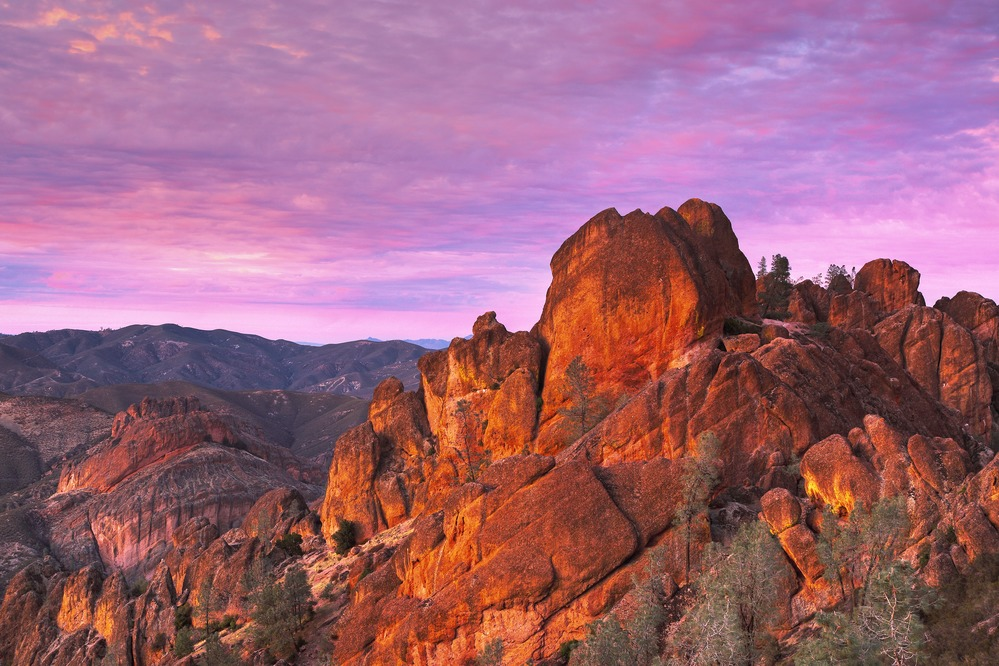
Pinnacles National Park has two big draws, and they don’t run on the same schedule. One is the California condor — the biggest bird in North America, and one of the rarest. The other is a pair of talus caves you can actually walk through, if they happen to be open the day you show up. Plan around only one of those and you’ll probably miss the other.
Here’s how the timing actually works, and how to plan a visit that gives you a real shot at both.
When You’ll Actually See a Condor
Good news first: condors don’t migrate, so there’s no single “condor season” to aim for. Pinnacles’ resident birds are around year-round, and the park’s own condor-viewing guidance is refreshingly specific about how to actually spot one instead of just saying “look up.”
Go early morning or early evening. Condors ride thermals to soar, and thermals need the sun to build up heat — which means the middle of a hot afternoon is often the quietest window, not the best one. Dawn and dusk are when you’re most likely to see them lift off and start circling.
Pick your viewpoint based on how much you want to hike. The High Peaks and the ridge southeast of the campground are the classic spots, but High Peaks is a genuinely strenuous trail with narrow, exposed sections — not a casual stroll. If you’d rather not commit to that climb, the Bench Trail near the Pinnacles Visitor Center is an easy, flat walk that comes with two mounted spotting scopes already pointed at likely condor territory. Most first-time visitors should start there before deciding whether High Peaks is worth the effort that day.

Know how to tell a condor from a turkey vulture, because at a distance they’re an easy mix-up and Pinnacles has plenty of both. A condor’s wingspan runs about 9.5 feet, nearly double a turkey vulture’s 5.5 feet, and from below an adult condor shows a bold white triangle on the leading edge of each wing, where a turkey vulture’s pale markings sit along the trailing edge instead. Flight style is the fastest tell: condors hold their wings flat and glide without rocking, while turkey vultures fly with their wings in a slight V and wobble side to side as they go. Every wild condor also carries a numbered wing tag — if you can read a number, you’re definitely not looking at a vulture.
Bear Gulch Cave and Balconies Cave: What’s Actually Open
This is the part that trips people up. Pinnacles has two talus caves — Bear Gulch on the east side, Balconies on the west — and neither one is guaranteed open on any given day. Both protect a colony of Townsend’s big-eared bats, a state-recognized sensitive species, and the lower section of Bear Gulch Cave in particular follows a real, recurring annual pattern: it’s closed completely from mid-May through mid-July for bat pupping season, and it opens in full for at least a week (sometimes up to four) each March and October. Outside of that window, the lower cave is typically open, though flooding or rockfall can close either cave on short notice regardless of season.

None of that is something to guess about. The park maintains a live cave status page that names exactly which sections of Bear Gulch and Balconies are open or closed right now, and it’s worth checking the day before you go, not just when you’re planning the trip weeks out. If a cave you were counting on turns out to be closed, both trails around it are still genuinely worth hiking on their own — you’re just not getting the walk-through-a-boulder-pile part that day.
So When’s the Actual Best Time to Try for Both?
Spring and fall are your best bet, and it’s not close. Both seasons sit outside the mid-May-to-mid-July cave closure, avoid the worst of the Central Valley-adjacent summer heat, and still give you decent morning thermals for condor activity. Summer at Pinnacles isn’t just uncomfortable — the park’s current conditions page regularly flags very high fire danger in the hotter months, with real restrictions on campfires, charcoal, and even roadside parking. None of that is a reason to skip a summer trip if it’s your only option — condors are still around, and the caves may well be open outside the pupping window — just budget extra water, start hiking earlier than you think you need to, and don’t count on the caves specifically without checking the status page first.
If you’d rather not navigate the High Peaks terrain solo on your first visit, a guided hike is worth considering — a local guide who already knows where the condors have been active and how the trail conditions are running can save you a wasted early-morning climb.

A Few Logistics Worth Knowing Before You Go
Pinnacles is split into an East Division and a West Division, and there’s no through-road connecting them inside the park — if you park on one side, you’re hiking on that side unless you’re willing to drive all the way back around. The east side has the Bear Gulch area, more shade, and reliable water; the west side has Balconies Cave and the higher rock walls that draw rock climbers. Decide which cave and which viewpoints you actually want before you pick an entrance, since backtracking mid-day isn’t a quick fix here.
Bring more water than you think you need, check both the cave status page and current conditions page within a day or two of your visit, and go early. That combination is most of what separates a trip where you see a condor and walk through a cave from one where you do neither.



Leave a Reply