
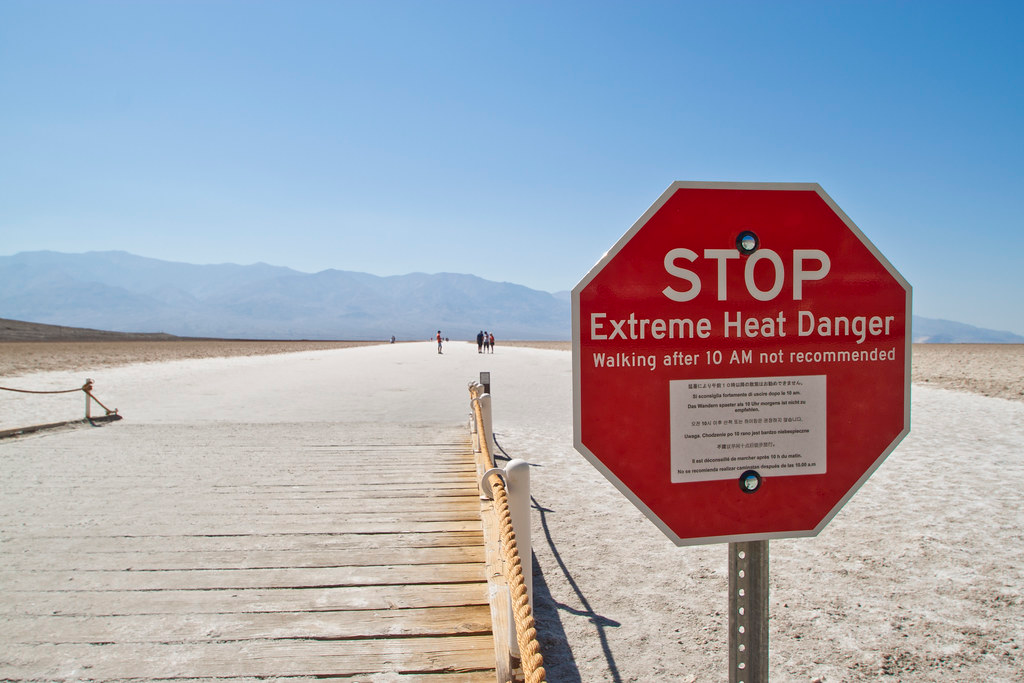
The quick answer: yes, you can visit Death Valley in summer and come home fine — but “safe” here means something more literal than it does almost anywhere else in California. This isn’t a place where the worst case is a sunburn and a long line for parking. The National Park Service’s own numbers say people die here most summers, and the mistakes that get them are almost always avoidable: hiking at the wrong time of day, wandering too far from the car, or underestimating how fast 100°F turns into a real emergency.
This article may contain affiliate links. If you book or buy through one, California Wanderer may earn a small commission at no extra cost to you. As an Amazon Associate I earn from qualifying purchases.

How hot does it actually get?
Death Valley holds the official world record for hottest air temperature ever reliably recorded on Earth: 134°F, measured on July 10, 1913. That’s the number that makes headlines, but it’s not really what should worry you — the day-to-day summer reality is more relevant, and it’s still brutal.
2024 was the park’s hottest summer on record: an average 24-hour temperature of 104.5°F, which beat the previous records set in 2021 and 2018. July that year was the hottest month ever logged at the Furnace Creek weather station, with nine straight days at or above 125°F and overnight lows that never dropped below 100°F on nine separate nights. Read that last part again — the low temperature, at 3 a.m., stayed above 100°F. There’s no cooling off after sunset the way there is almost everywhere else.
That same summer, the park recorded multiple life-threatening heat incidents, including two deaths where heat was a contributing factor and one rescue involving a hiker with second-degree burns from contact with the ground. This isn’t a hypothetical risk NPS is citing to be cautious — it’s a documented, recent pattern.
What the Park Service actually recommends
The NPS is direct about this, and worth quoting rather than paraphrasing: they do not recommend hiking in the lower elevations in the summer, full stop. Their own guidance notes that even when the air temperature is only in the 80s or 90s, “it can be deadly” — most visitors badly underestimate how much stronger direct desert sun is than the thermometer reading suggests.
For anyone driving through (which is most visitors, even in summer), the advice is just as blunt: stay on paved roads, and stay close to your vehicle. If your car breaks down, stay with it until help arrives — don’t set off on foot looking for help. Tow companies can be hours away, so carry extra drinking water in the car specifically for a breakdown scenario, not just for drinking on the drive.

What to Pack for Death Valley in Summer
- a collapsible water container — a collapsible jug means you can carry the extra gallons NPS recommends for the car without it taking up trunk space the rest of the year.
- electrolyte powder packets — plain water isn’t enough once you’re sweating this much; NPS specifically recommends replacing salt, not just fluid.
- a reflective windshield sunshade — a reflective windshield shade keeps your parked car’s interior survivable and takes real strain off the AC the moment you’re back inside it.
On hydration, the park’s guidance is a specific number: drink at least one gallon (about 4 liters) of water per person, per day, to replace what you’re sweating out. Water alone isn’t enough, either — NPS recommends salty snacks or an electrolyte drink alongside it, since sweating this much also strips your body of salt. If you start feeling dizzy, nauseous, or get a headache, that’s your cue to get out of the sun immediately and start drinking water or a sports drink — heat illness escalates fast here, and NPS’s own wording is that it “can be severe and sometimes deadly.”
Motorcyclists get a specific, separate warning: officials say riders are injured or killed by the heat every summer, and once the heat index passes about 99°F, moving air at speed stops providing any real cooling — combined with the insulating effect of riding gear, that’s a dangerous combination the park explicitly tells motorcyclists to plan around. If you’re set on riding through in summer anyway, NPS recommends riding before 10 a.m., taking frequent air-conditioned breaks, and planning your route in advance since cell service is limited through most of the park.
Who should actually skip the summer visit
Given all that, a few groups are better off waiting for cooler months (roughly October through April, when daytime highs are far more reasonable): anyone with a heart condition or another health issue that makes heat stress riskier, young kids and older adults generally, motorcyclists as covered above, and any hiker whose plan involves real mileage at low elevation rather than a short walk from an air-conditioned car.
If none of that applies to you and you’re comfortable with the precautions above, a summer visit is genuinely doable — you’ll also get the park close to yourself, since most visitors already know to come in the cooler months.

Before you go: check current conditions
Death Valley’s roads and facilities change with the season and with storm damage more than most parks — always check the NPS’s official current alerts and conditions page before you drive out, for any road closures, facility closures, or advisories in effect on your actual travel dates.

Quick FAQ
Is Furnace Creek air-conditioned? Yes — the visitor center, the general store, and the resort at Furnace Creek all have air conditioning, and they’re the standard “cool off” stop for most summer visitors.
Can I still see Badwater Basin in summer? Yes, and plenty of people do — it’s flat, close to the road, and most visitors are only out on the salt flat for 10–15 minutes. Just don’t linger, and don’t attempt it in the early afternoon if you can help it.
Is gas reliably available in the park? Furnace Creek and Stovepipe Wells both sell gas, but Death Valley is enormous and distances between services are long — top off before you arrive and don’t let the tank get low, since an empty tank in extreme heat turns a minor inconvenience into a real emergency.

Leave a Reply