
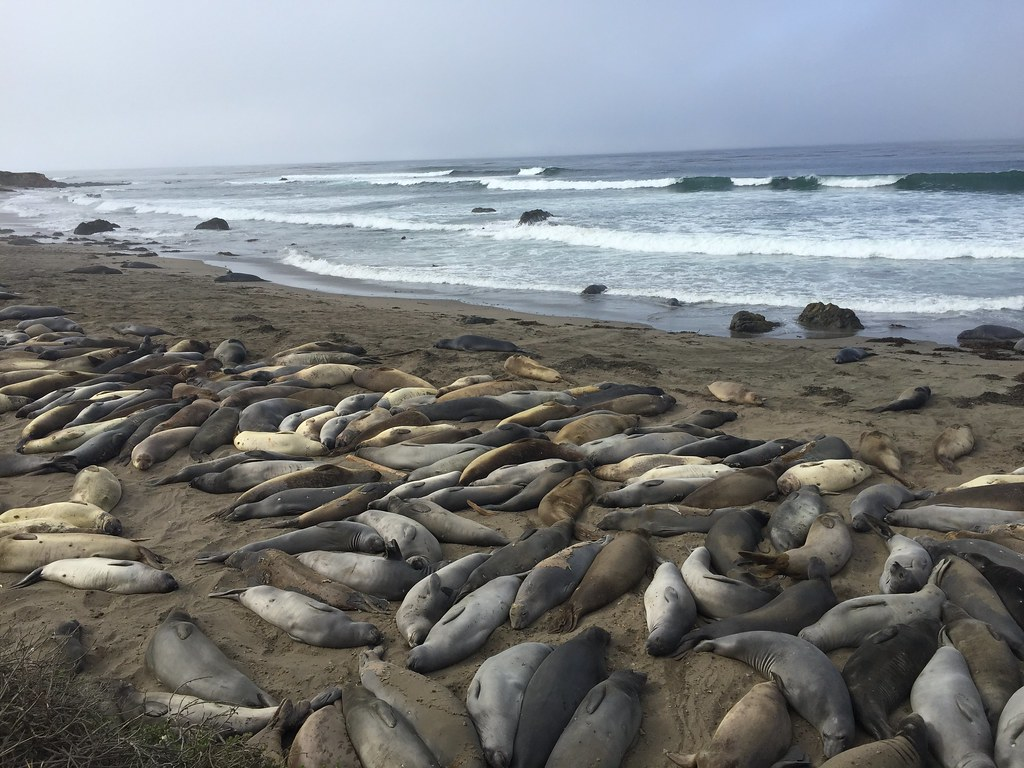
Quick answer: the best time to see elephant seals at San Simeon is December through March, when the beach at Piedras Blancas fills with battling bulls, birthing cows, and thousands of pups. But there isn’t really a bad time — this is one of the only rookeries in the world where you can watch elephant seals doing something interesting, for free, in any month of the year.
When to Go: Elephant Seal Season Month by Month
The colony follows a predictable rhythm, and it’s worth knowing which “act” you’re walking into:
- December–March (the big show): Males start arriving in November to stake out territory and fight for it — loudly. Females follow in December and January to give birth, and late January is when births peak, with the beach holding close to its annual high of around 17,000 seals.
- April–June (molting season): Adult females and juveniles haul out to shed their skin and fur in patches. It’s less dramatic than breeding season but still a genuinely strange thing to watch.
- September–October (the awkward-teenager phase): Juveniles show up in a second haul-out, and the population climbs again toward that same ~17,000 mark.
Elephant seals also rest hard during the warmest part of the day, so if you want to see actual movement — not just a beach full of very large, motionless logs — get there in the morning.
Where to See Them: Piedras Blancas Vista Point
The viewing area sits on Highway 1, about four miles north of Hearst Castle and seven miles north of San Simeon proper. It’s open every day of the year, sunrise to sunset, and it’s completely free — no reservation, no ticket, no gate.
The vista point has wheelchair-accessible viewing platforms right above the beach, which is part of what makes this rookery unusual: most elephant seal colonies require a hike or a permit to see. There are no restrooms on-site, so plan around that if you’re bringing kids. Volunteer docents from Friends of the Elephant Seal staff the boardwalk daily from 10 a.m. to 4 p.m. and are genuinely useful — they’ll point out which seals are which, explain what you’re watching, and answer the questions you didn’t know you had.
Piedras Blancas vs. Año Nuevo: Don’t Mix These Up
If you’ve searched around for elephant seal viewing in California, you’ve probably also seen Año Nuevo State Park come up. They’re not interchangeable, and mixing them up can wreck a trip plan:
- Piedras Blancas is free, unguided, and open every day, all year. Just pull into the lot and walk out to the boardwalk.
- Año Nuevo, near Santa Cruz, requires a mandatory guided walk from December through March — you cannot see the seals there during breeding season without a reserved spot, and those reservations open through ReserveCalifornia months in advance. Outside that window (April–November), Año Nuevo switches to a free self-guided permit instead.
Neither approach is “better” — they’re just different systems. If you want to just show up on a random Tuesday and watch seals with zero planning, Piedras Blancas is the one that lets you do that.

Is the Guided Arroyo Laguna Walk Worth $13?
Piedras Blancas also has its own optional paid option: California State Parks’ Elephant Seal Tours, a docent-led walk to Arroyo Laguna, about 2.25 miles north of the Hearst Castle entrance. As of the site’s most recently posted 2026 schedule, tours ran Fridays and Saturdays in February, with departures at 9:30 and 10:30 a.m., for $13 per person (parking’s free, and it’s credit card only at the gate) — check the current schedule before you drive out, since the season and days can shift year to year.
It’s a 45-minute, half-mile walk over loose, sometimes muddy terrain, and it gets you closer to a part of the colony you won’t see from the main vista point. Worth it if you’re already committed to a deeper visit or traveling with someone who wants the narrated version. Skip it if you’re just passing through on a Highway 1 road trip — the free vista point alone is a completely satisfying stop.

Safety and Rules at the Viewing Area
These aren’t suggestions — disturbing elephant seals is illegal under state and federal law. The National Marine Fisheries Service, which enforces the Marine Mammal Protection Act, recommends staying 50 to 100 feet back at minimum. A simple gut check: if a seal is looking directly at you, you’re probably too close.
Well-behaved dogs are allowed at the viewing area on a leash, but keep them far from the seals — a curious dog and a 3,000-pound bull are not a good combination for anyone involved. And don’t expect much action midday; the seals mostly sleep through the warmest hours, so the morning advice above isn’t just about parking.
Where to Stay Near San Simeon
Most people see the seals as a stop on a Highway 1 drive rather than a standalone trip, and San Simeon itself is thin on hotel options. If you want to actually base yourself nearby, Ragged Point Inn, just north on Highway 1, is the most-recommended option directly on this stretch of coast — otherwise, Cambria (about 8 miles south) has the area’s real concentration of inns and motels.
Either way, budget flexible time at the vista point itself rather than a tight window — the seals aren’t going anywhere, but traffic on Highway 1 can make “just a quick stop” take longer than you’d think.


Leave a Reply