Santa Barbara calls itself the American Riviera, and for once the nickname undersells the place instead of oversells it. It’s a city where a Spanish Colonial courthouse doubles as the best free view in town, where the main shopping street has spent years figuring out whether cars belong on it at all, and where the boat to a genuine national park leaves from the next town over. It rewards a plan more than most beach towns do, and it punishes a rushed one — this guide is built to prevent both.
This article may contain affiliate links. If you book or buy through one, California Wanderer may earn a small commission at no extra cost to you. As an Amazon Associate I earn from qualifying purchases.
Quick answer: If you only have a day, climb the free clock tower at the Santa Barbara County Courthouse for the best skyline view in the city, walk the car-free stretch of State Street down to the water, and end at Stearns Wharf. With two or three days, add the Old Mission, a half-day boat trip to Channel Islands National Park out of nearby Ventura Harbor, and an afternoon working through tasting rooms in the Funk Zone.
Santa Barbara At a Glance
| Do This | Best For | Time Needed | Cost |
|---|---|---|---|
| Santa Barbara County Courthouse clock tower | Views, first-timers, photographers | 30–45 minutes | Free |
| State Street Promenade | Shopping, dinner, people-watching | 1–3 hours | Free to walk |
| Old Mission Santa Barbara | History, architecture | 45–60 minutes | Paid self-guided tour |
| Stearns Wharf & the harbor | Sunset, seafood, an easy stroll | 1–2 hours | Free to walk |
| Channel Islands National Park | Hiking, wildlife, a real day trip | Full day | Ferry fare (park entry is free) |
| Funk Zone & Urban Wine Trail | Wine, murals, an afternoon on foot | 2–4 hours | Tasting fees vary |
| Santa Barbara Zoo | Families, ocean-view animal exhibits | 2–3 hours | Paid admission |
| Santa Barbara Botanic Garden | Native plants, quiet trails | 1–2 hours | Paid admission |
| Butterfly Beach | Sunset, a quieter beach than the main strand | 1 hour+ | Free |
| Chumash Painted Cave State Historic Park | A quick, offbeat detour into the hills | 30–45 minutes round trip from the pullout | Free |
Santa Barbara County Courthouse: Free, Iconic, and the Best View in Town
Start here. The Santa Barbara County Courthouse is a working government building — it still hears cases — but it’s also a full-blown Spanish-Colonial Revival landmark, built in the late 1920s with hand-painted murals, wrought iron, and tile work that make it feel more like a small palace than a county office. The courtyard and sunken garden are open to wander for free, and the real draw is the clock tower: an elevator and a short staircase put you above the rooftops for a 360-degree view that takes in the mountains, the harbor, and the Pacific in one turn.
It costs nothing, takes under an hour, and works at almost any point in a trip — early morning for the clearest light, or late afternoon before the tower closes, for a golden-hour version of the same view. Docent-led tours run on select days through the Courthouse Legacy Foundation and are worth checking if your visit lines up with one.

Walk State Street, Santa Barbara’s Car-Free Promenade
State Street is the city’s main commercial spine, and for several blocks near the water it’s been closed to car traffic since 2020 — first as a pandemic measure, then extended repeatedly while the city works out a permanent design. As of mid-2026, the City of Santa Barbara’s own State Street page confirms the car-free stretch has been extended through at least the end of the year while a permanent master plan is finalized, so check that page before you go if the exact block boundaries matter to your plans — it’s genuinely still in flux, not a settled, permanent pedestrian mall yet.
In practice, that means several blocks of restaurants, shops, and outdoor seating with no traffic to dodge — good for an aimless wander, dinner outside, or ducking in and out of stores without circling for parking. The Arlington Theatre’s marquee and Spanish-tile storefronts make it one of the more photogenic main streets in Southern California, and it connects directly toward the waterfront and Stearns Wharf if you want to keep walking.

Old Mission Santa Barbara, the “Queen of the Missions”
Old Mission Santa Barbara earned its nickname honestly — founded in 1786, it’s widely considered the best-preserved and most architecturally striking of California’s 21 missions, with twin bell towers and a classical facade that still functions as an active Franciscan parish. A self-guided tour ticket gets you into the church, the cemetery, and the museum rooms that walk through the mission’s Chumash, Spanish, and Mexican-era history — including the parts of that history that weren’t voluntary for the Chumash people who built and lived at the mission, which the museum addresses more directly than it once did.
Give it 45 minutes to an hour, more if you read the exhibit text closely. The rose garden across the street and the mountain backdrop make the building itself worth a slow lap before you even go inside.

Stearns Wharf and the Waterfront
Stearns Wharf has been standing since 1872, which makes it one of the oldest continuously operating wharves on the West Coast, and it still does what a wharf is supposed to do: get you out over the water on foot, past seafood restaurants, a small aquarium annex, and a candy shop, to a view back at the city and the mountains behind it. It’s free to walk, wheelchair- and stroller-friendly, and a natural bridge between State Street and the beach.
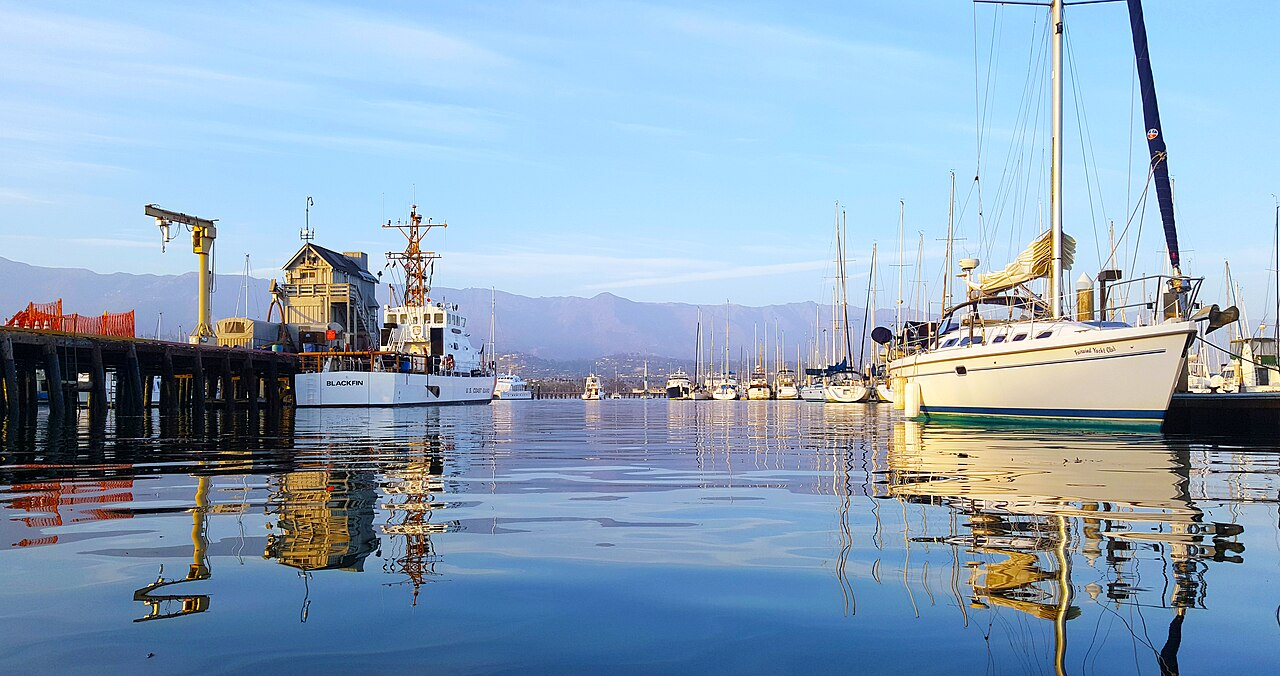
From the base of the wharf, the harbor itself is worth a short detour — a working marina with fishing boats and sailboats rather than a purely decorative one, with a farmers’ market of fresh local seafood (“Fish Market”) that runs on weekends near the harbor entrance. The City of Santa Barbara’s waterfront page lists current boat tour operators, harbor cruises, and seasonal whale-watching trips if you want to get out on the water without committing to a full Channel Islands day.

Take a Boat to Channel Islands National Park
This is the one visitors most often miss, and it’s arguably Santa Barbara’s single best day trip. Channel Islands National Park — sometimes called California’s Galápagos for the number of species found nowhere else on Earth — sits just offshore, but the ferry doesn’t leave from Santa Barbara itself. Island Packers, the park’s official concessionaire, runs boats out of Ventura Harbor, roughly a 30–45 minute drive south of downtown Santa Barbara, with year-round service to Anacapa and Santa Cruz Islands and seasonal trips further out to Santa Rosa, San Miguel, and Santa Barbara Island.
Anacapa is the closer, more compact option — a good pick for a single day, with sea caves, an arch rock formation, and a lighthouse marking the island’s eastern tip. Santa Cruz is larger and better for longer hikes and kayaking into sea caves. Park entry itself is free; you’re paying for the ferry. Still deciding between the two? Our Anacapa vs. Santa Cruz guide goes deeper into which one actually fits your first day trip. Book Island Packers directly, bring layers (it’s colder on the water than it looks from shore), and check the schedule before planning your day around a specific island, since departures vary by season.

Sip Your Way Through the Funk Zone and Urban Wine Trail
The Funk Zone is a compact, walkable warehouse district — roughly ten blocks — wedged between the train station, the beach, and downtown, where old industrial buildings have been turned into wine tasting rooms, breweries, galleries, and murals instead of torn down. It’s the most concentrated stretch of the Santa Barbara Urban Wine Trail, which lets you taste Santa Barbara County wine — famous for Pinot Noir and Chardonnay grown in the Santa Rita Hills and Santa Ynez Valley — without renting a car or driving between wineries at all.
The neighborhood’s name comes honestly from its past as a low-rent industrial and fishing-supply zone before wineries and galleries moved in during the 2000s, and the murals covering many of the old warehouse walls are as much a reason to walk the blocks as the wine itself.
Most tasting rooms open around midday and stay open into the evening, so it works equally well as a lazy afternoon or a pre-dinner stop before walking to State Street. Many pours are $15–25 for a flight, and several rooms allow you to carry a glass between neighboring patios, which is part of why the district works so well on foot. If you’d rather have someone else plan the route and pour the pours, consider a guided Santa Barbara wine-tasting tour — a straightforward way to hit several tasting rooms without doing the logistics yourself.
See Giraffes with an Ocean View at the Santa Barbara Zoo
The Santa Barbara Zoo is small by big-city standards — around 30 acres — and that’s part of its appeal: it’s genuinely walkable in a couple of hours without the exhaustion of a full-day zoo trip, and several exhibits, including the giraffe yard, have an actual ocean view behind them, which is not a sentence you get to write about most zoos. It sits right along the water near East Beach, so it pairs naturally with an afternoon at the beach or a ride on the beachfront path.
It’s a genuinely good family stop, but adults without kids in tow shouldn’t write it off either — the giraffe feeding, when it’s running, is one of the better hands-on wildlife encounters in the city.

Wander the Santa Barbara Botanic Garden
Tucked into Mission Canyon just above the Old Mission, the Santa Barbara Botanic Garden is dedicated entirely to California native plants — meadows of wildflowers in spring, oak woodlands, redwoods, and a historic dam and watershed trail — spread across paved and unpaved paths that range from flat and stroller-friendly to a genuine short hike. It’s quieter and slower-paced than most of this list, which makes it a good counterweight to a day spent on State Street or the wharf.
Spring (roughly March through May) is the showiest season for wildflowers, but the garden’s oak and redwood sections hold their own year-round. Check the garden’s own visit page for current reservation requirements before you go, since timed-entry policies have shifted from year to year.

Watch the Sunset at Butterfly Beach
East Beach and West Beach get most of the foot traffic downtown, but Butterfly Beach, tucked into Montecito just past the Biltmore, is the one locals point visitors toward for sunset — a rockier, quieter stretch of sand with a clear westward view over the water and the city lights curving back toward the harbor as the sun drops. There’s no boardwalk or concession stand here, which is more or less the point.
Street parking along Channel Drive is limited, so arrive with some buffer time, especially on weekends. It’s a short walk if you’re already staying in Montecito, or a quick drive from downtown.

Chumash Painted Cave State Historic Park: A Quieter Piece of History
Chumash Painted Cave State Historic Park is one of the smallest state parks in California — a single sandstone cave a short walk from a roadside pullout in the hills above the city, holding rock art created by the Chumash people, whose name for the site is Alaxuluxen. It’s genuinely worth the detour for how different it feels from everything else on this list: no crowds, no admission fee, and a real piece of Indigenous California history rather than a recreation of one.
Set expectations correctly, though: the cave itself sits behind a protective metal gate to prevent vandalism, so you’re viewing the pictographs through the grate rather than walking inside, and the roadside pullout fits only one or two cars — trailers and RVs shouldn’t attempt the narrow access road up Painted Cave Road off Highway 154. It’s open dawn to dusk daily and the visit itself takes well under an hour, which makes it an easy add-on for anyone driving toward the wine country of the Santa Ynez Valley.

Where to Stay in Santa Barbara
Santa Barbara doesn’t have a single “best” neighborhood to stay in so much as a set of trade-offs. Staying downtown near State Street puts you within walking distance of the courthouse, restaurants, and the wharf, but summer weekends book up early and prices climb accordingly. The waterfront strip near East Beach and the harbor trades a few blocks of walkability for ocean views and easier beach access. Montecito, just southeast of the city, is quieter and more residential, with Butterfly Beach and the Biltmore nearby, but it puts you a short drive from downtown attractions rather than a walk. Visit Santa Barbara’s own lodging directory is a good starting point for browsing by neighborhood and property type.
If you’re still comparing neighborhoods and dates, it’s worth checking what’s actually open and at what price for your specific trip, since rates here swing hard between a quiet January weekday and a July Saturday.
Best Time to Visit Santa Barbara
Santa Barbara’s climate is mild enough that there’s no genuinely bad time to visit, but the seasons do trade off in predictable ways. Late spring (May through June) often brings a coastal marine layer — locally, “May gray” and “June gloom” — that can keep mornings overcast even when inland California is already hot; it usually burns off by early afternoon. Summer is the busiest and most expensive season, with the clearest run of sunny days but the heaviest crowds on State Street and the beaches. Fall (September through October) is arguably the sweet spot: warm, reliably sunny, and noticeably less crowded than summer, since it falls after most school-year vacations end. Winter is mild by most standards but does bring the bulk of the region’s rain, concentrated in a handful of storms rather than spread evenly across the season, and it’s also prime whale-watching season offshore.
For a Channel Islands trip specifically, check Island Packers’ schedule before locking in dates — winter storms can cancel crossings on short notice, and access to the more distant islands is seasonal in the first place. If your dates are flexible, it’s also worth checking whether they overlap with Old Spanish Days (locally called Fiesta), Santa Barbara’s long-running early-August celebration of the city’s Spanish and Mexican heritage — parades, rodeo events, and street markets take over downtown for several days, which is either a highlight or a scheduling headache depending on whether you’re looking for a party or a quiet trip.

Getting To and Around Santa Barbara
Santa Barbara sits directly on US-101, roughly a 90-minute to two-hour drive from Los Angeles depending on traffic, and about the same from the Bay Area in the opposite direction — closer to five hours from San Francisco. Santa Barbara Airport (SBA) has direct flights from several West Coast hubs and cuts that drive out entirely if timing matters more than cost. Amtrak’s Pacific Surfliner also stops right downtown, within walking distance of State Street, which is a genuinely pleasant way to arrive if you don’t want a car for a downtown-focused visit.
Once you’re there, downtown, the waterfront, and the Funk Zone are all walkable to each other, and the free downtown-Waterfront electric shuttle covers the stretch between State Street and the wharf if you’d rather not walk it twice in one day. A car (or rideshare) becomes genuinely useful once your plans include the Botanic Garden, the Zoo, Butterfly Beach in Montecito, or the drive up to Chumash Painted Cave — none of them are realistically walkable from downtown, and downtown street parking during peak season is tighter than the drive time between sights would suggest. Several public parking structures sit just off State Street, and per the city’s own downtown parking page, the first 75 minutes are free in gated lots once per 24-hour period — usually enough for a quick courthouse-and-lunch stop but not for a full afternoon of shopping. Check that page for current hourly rates once you’re there, since the city adjusts them periodically.